“The best way to predict the future… is to invent it”
Alan kay (American computer scientist)
Global Networks and Military use
One ‘click’ and you could connect to anyone anywhere around the globe, making communication so much easier than it was hundreds of years ago. No horses or pigeons needed to send your messages. Handy and really efficient.
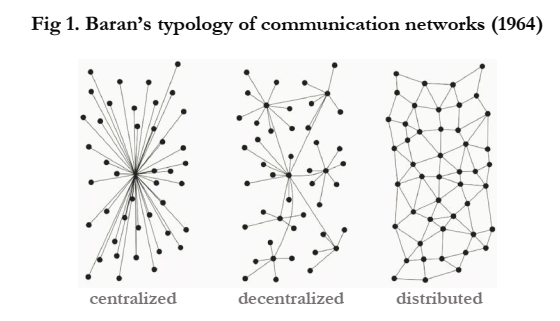
How does that work? Our devices rely on communication systems or pathways which are of two types, centralised or decentralised. These infrastructures are connected by nodes.
When telegraph was introduced, a star-shaped typology was formed. Where one server (central server/node) manages all the other nodes and processing. Other servers transmit signals and connect to the central server to have their messages sent. Thus, this is called a centralised infrastructure where the central node takes lead. The messages are sent across nodes and neither manpower nor a long period of time is needed to send messages around. But, If it’s overloaded or taken down, everything else connected also comes crashing down. Communication is lost and the infrastructure becomes useless. Using a centralised infrastructure is inevitably vulnerable.
During the nuclear war, centralised networks were always used between military stations and soldiers to maintain contact and transmit signals. Since, everyone knew about the infrastructure, the central node would always be attacked by enemies in other to crash down all communications. in order to prevent the network becoming a vulnerability, Paul barren brought up decentralised network(mesh network topology).
Mesh network topology is a distributed network where a central node is unnecessary to allow nodes to intercommunicate. All nodes could individually transmit signals and communicate efficiently and the biggest gain from this is that even if one or more nodes were destroyed or taken down by someone, information would still pass around every other node. In this case, military bases.
Attention economy and the long tail effect
Everyone has their own devices, people use the internet aka online world everyday.
Any procedure that brings data together and presents it in a summary manner is referred to as data aggregation. It’s most commonly utilized before running a statistical analysis. Collecting and analysing data making it into something profitable or beneficial is significant but gets hard by human being doing it alone. A lot of manpower and time would be needed but with the help of computers and the system of data aggregation. It’s not only faster but more accurate. Data aggregation allows high volumes and forms of data to be processed and obtained from its rawest forms. Giving companies the results they’re looking for faster and more accurately.
A lot of big companies profit from this such as Google and Facebook. Our online activity is processed and analysed by this process, users are shown ads and suggested pages to follow or go through that have paid the companies and could be where users would spend their money on. This way, Google and Facebook profit from data aggregation.
Originally, long tail is a business strategy where companies sell products that are desired in smaller amounts increasing their demand. But things have changed in this society, long tail is converted into attention economy. This era is constantly lost in the world of trends, everyone wants to buy Gucci products or watch Squid game to climb up on the trend ladder. As long as some show or product is getting sufficient attention, it’s gaining success and profiting but other shows that aren’t on the trending lists are getting filtered out beneath the trends. Shows like the loud house are going through the long tail effect since they’re not on top of searches like ‘Friends’.
Each scroll or click counts in this attention economy where the long tail effect has a major role in. Going deeper into the internet to find something more relevant to you or more desirable, helps niche get more recognition. Long tail power laws apply in the attention economy when the clicks aren’t following the path of other users.

References:
lecture notes and readings (Kat AHUJA)
 All my love 🥰